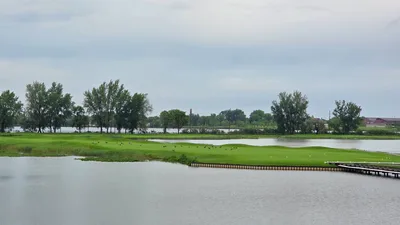
Calling all long ballers! The Chicago area boasts an incredible golfing landscape, catering to players of all skillsets. But for those who crave the ultimate test of power and precision, this list unveils the longest holes on Chicagoland public courses. Prepare to unleash your inner bomber, because these behemoths stretch far beyond the average par-5. We're talking titans exceeding a staggering 700 yards, demanding not just raw power, but strategic shot selection and course management. These holes push even the most seasoned golfers to their limits.
Dial in your driver settings, grab your most reliable long irons, and take dead aim.
Note: On each image, the tee box is on the left, and greens are on the right.
Top 10 Hole Length Comparison
Course Locations

Chapel Hill Country Club
Out in McHenry county, the 17th at Chapel Hill is an absolute beast -- the longest in all of Chicagoland. There's actually two blue tees on this hole to choose from: the 703 full length distance, or a 605 yard version which is still plenty long. A wild thing about this course having the longest hole is that the entire course is only 6,113 yards. The 17th hole accounts for almost 12% of the entire distance. Furthermore, Chapel Hill CC is by far the shortest course in this top 10 list, by about 500 yards!
Luckily there's no water or bunkers to contend with. However, the fairway is extremely narrow the entire length of the hole -- only about 22 yards wide. With a small green.
Overall this muni is a humble affair, with course conditions on the lower end of Chicagoland golf venues. Although, isn't it worth playing here just to say you've attempted a 700 yard par-5?
Notable Features
- Longest hole in all of Chicagoland at 703 yards
- Optional 605-yard tee for the faint of heart
- Fairway only ~22 yards wide -- bring your A game

Golf Club of Illinois
With a course rating of 74.4 from the back tees, you knew this track was going to test you. The 11th hole at hilly Golf Club of Illinois is a mid-round challenge that has the potential to blow up your scorecard. The hole is named "Grant's March" and a Chicago Tribune article from May 1994 claims it was the longest par-5 in America at the time.
Two strategically-placed fairway bunkers aim to gobble your golf balls, while five greenside bunkers look to add insult to injury on this 678-yarder. The green is one of the smallest at the club. Also, keep your slice in check; there's OB to the right, with homes lining the entire starboard side of this gargantuan hole.
Notable Features
- Named "Grant's March" -- and it feels like one
- Claimed longest par-5 in America in 1994
- OB right with homes lining the entire right side

Shepherd's Crook Golf Course
This gem of a course nestled on the Wisconsin border will challenge all aspects of your game. From the back tees, the 14th at Shepherd's Crook can be played as either a 654-yard colossus, or a slightly more reasonable 617-yard affair. Of course, it's a tough hole either way. The 654-yard tee box is just a small, round, isolated bump next to a utility area; this is where the psychological torture begins. From there, your drive must avoid fairway bunkers on the right side, so hopefully you have favorable wind and don't slice it. At least the fairway is forgiving -- as wide as 50 yards in some parts.
If successful on the first shot, you now face the real test: a creek runs across the fairway at about 490 yards from your original tee shot. Only the biggest hitters will be able to clear the water with their second shots. Do you have what it takes?
Notable Features
- Optional 617-yard tee if 654 is too spicy
- Creek crosses fairway at ~490 yards -- a true test
- Fairway up to 50 yards wide in places

University Park Golf Club
From the back tees on hole 16 at University Park, you need to drive it 265 yards to reach the fairway. Said fairway is about 25 yards wide, but there's no bunkers to worry about unless you're way offline. Unfortunately you do need to worry about the figure eight-shaped pond on the left side of the green.
Fun fact about this hole: it is not the #1 handicap hole. It's #2. At this length, it's obviously a challenging ordeal. So challenging, in fact, that both very good and just-average golfers are likely to struggle with the hole. And that's a clue to how the golf hole handicapping system works. The handicap rank of each hole isn't just based on difficulty; it's based on the disparity in scores between very good players vs average players.
Notable Features
- Need a 265-yard drive just to reach the fairway
- Figure eight-shaped pond guards the green
- #2 handicap hole, not #1!

Whisper Creek Golf Club
Number 8 at Whisper Creek gives you a lot to think about. First of all, can we talk about the tee box names? There's five tees and they're called Oak, Pine, Birch, Willow, and Maple. Somewhat pretentious and confusing? Yes. But more immediately, golfers face loads of problems on the mighty 8th hole. The South Branch Kishwaukee River runs directly through the heart of it. The S-shaped layout presents confusing angles off the tee box and second shots. The fairway narrows considerably for your opening tee shot.
Robust fescue grasses, wetlands, and even homes line the hole on this prairie-links style track -- all obstacles that can ruin your front-9 score. Proceed with extreme caution and vigilance.
Notable Features
- Kishwaukee River runs through the heart of the hole
- S-shaped layout with confusing angles
- Tee boxes named after trees (Oak, Pine, Birch, Willow, Maple)

Stonewall Orchard Golf Club
To be considered a great course, it really helps to have a great finishing hole. Hole 18 at Stonewall Orchard is exactly that. This beauty of a track way up in Grayslake is long, scenic, and a blast to play. Stonewall is the second most difficult course on this list (after Dubsdread) and it helps to think your way around the course, rather than just grip it and rip it. That holds true on this final hole too.
The green is narrow and flanked by water. The fairway approaching the narrow green forks into two paths. The left path is more direct, but narrow and flirts with the water; the right is wider, but elevated and further away.
I find it somewhat surprising that of all the long holes in this list, Stonewall's is the only finishing hole.
Notable Features
- Only finishing hole in this entire top 10
- Fairway forks into two paths near the green
- 2nd most difficult course on this list

Foxford Hills Golf Club
With a rating of 74.6 and slope of 142 from the back tees, Foxford Hills is the third most difficult course in this top 10. Golfers will notice the massive dogleg left immediately, along with the nice, wide fairway. It's generous, however it's littered with fairway bunkers. In fact, there's four bunkers in the heart of the fairway itself, a particularly cruel feature for an extremely lengthy hole. Overall, 16 bunkers aim to thwart your progress.
Notable Features
- 16 total bunkers on a very long hole. Brutal
- Massive dogleg left with wide fairway
- 3rd most difficult course on this list

Cog Hill Course #4 (Dubsdread)
By far the most prestigious course on this list (not to mention the most expensive by a mile) is Cog Hill #4, Dubsdread. The site of PGA Tour events for decades, along with various USGA championships, it has hosted the world's best numerous times. Tiger Woods holds the course record here with an incredible 62 at the BMW Championship in 2009. Here's a video of him playing the 9th hole that year, making a wild birdie from humble beginnings.
Large, mature trees encroach the narrow fairway, compounding any small mistakes. And like many greens at Dubsdread, this one is elevated and protected like a fortress by large bunkers. Just a devilishly difficult way to finish the front 9.
Notable Features
- Most prestigious course on this list
- Tiger Woods shot 62 here in 2009 BMW Championship
- Elevated fortress green protected by large bunkers

White Pines West Course
The driving range at White Pines is only about 250 yards deep, so you'll just have to mentally visualize the massive bomb you'll hit on the 11th hole when practicing. The dogleg left is narrow with lots of tree coverage, so take dead aim. A creek runs perpendicular to the fairway about 40 yards short of the green. That green is small and narrow. Godspeed.
Notable Features
- Narrow dogleg left with heavy tree coverage
- Creek crosses fairway 40 yards short of green
- Driving range is only 250 yards -- can't even practice for this

Tamarack Golf Club
The DuPage River flows about 1.5 miles east of Tamarack and supplies a tremendous amount of water on the course. Hole 12 is a major beneficiary, with a pond by the tee box, and a creek that cuts across the fairway and then alongside it. But pick your poison -- water on the left, or 11 giant fairway bunkers on the right.
Notable Features
- DuPage River feeds water hazards throughout
- 11 fairway bunkers on the right side
- Pick your poison: water left, sand right

Big Run Golf Club
I enjoyed compiling this list so much that I decided to provide a bonus 11th hole! Big Run lives up to its name and has fun elevation changes too. It can be a tough walk on a hot day. The long 9th hole has a valley of sorts in the middle, adding to the complexity of the sweeping dogleg right setup. The fairway is only about 20 yards wide. Large trees try to box you out as if they were grabbing rebounds on the court at the United Center. This is an extremely challenging hole, yet Big Run sports another 600 yard affair -- hole #15.
Notable Features
- Valley in the middle adds complexity
- Fairway only ~20 yards wide with big trees
- Big Run also has a 600-yard hole #15